At a glance
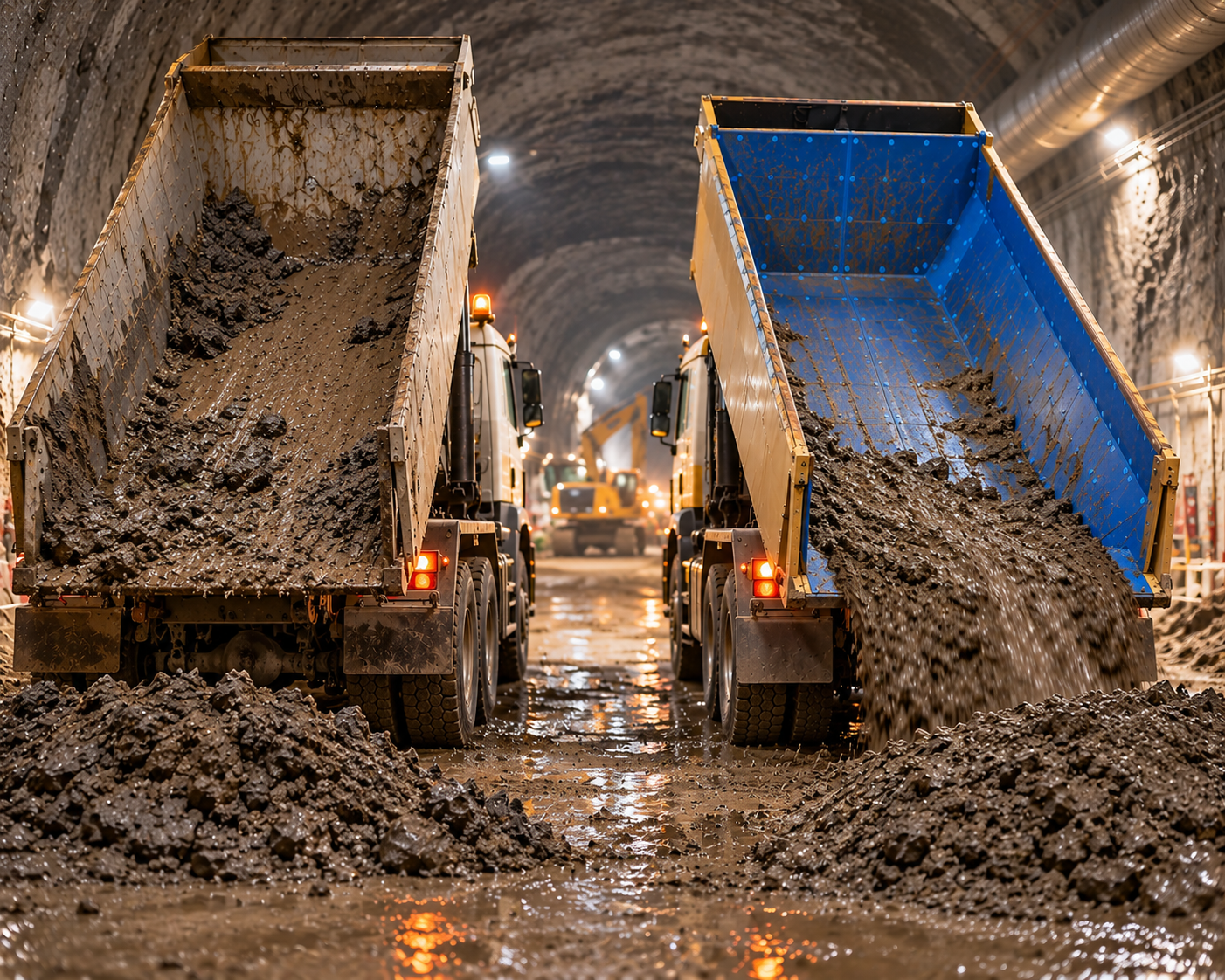
- Conditioned TBM spoil can form a cohesive mass that smears, compacts and hangs up against the truck body instead of releasing freely.
- When the spoil remains retained, the body may be raised further, increasing the centre of gravity and the risk of instability.
- A low-friction truck body liner and even load distribution can help the spoil move earlier and reduce the angle required to initiate discharge.
- Stable tipping zones, defined stop-work limits and ongoing discharge monitoring provide the additional controls needed to manage the remaining risk.
Conditioned TBM spoil can pose operational and safety risks once loaded into haul trucks. Variations in ground conditions, moisture content and conditioning can change discharge performance from one load to the next.
On constrained tunnelling sites, limited tipping space, variable ground conditions and continuous vehicle movements can further reduce the margin for error when spoil does not release as expected.
Here’s why sticky TBM spoil can force trucks towards dangerous tipping angles and how tunnelling sites can reduce the risk through improved material release, controlled unloading practices and correctly specified truck body liners.
Why Sticky TBM Spoil Forces Dangerous Tipping Angles
Conditioned TBM spoil often contains moisture, fine particles and foam or polymer additives that give it a plastic, cohesive consistency. Unlike dry fill or loose aggregate, which moves as individual particles, conditioned spoil can deform and discharge as a single mass.
The problem gets worse as the spoil sits in the truck body during transport. Moisture-rich fines smear across the floor and sidewalls while the load compacts against the steel or aluminium body. Dents, worn sections, corners and surface irregularities create additional resistance and areas where material can hang up.
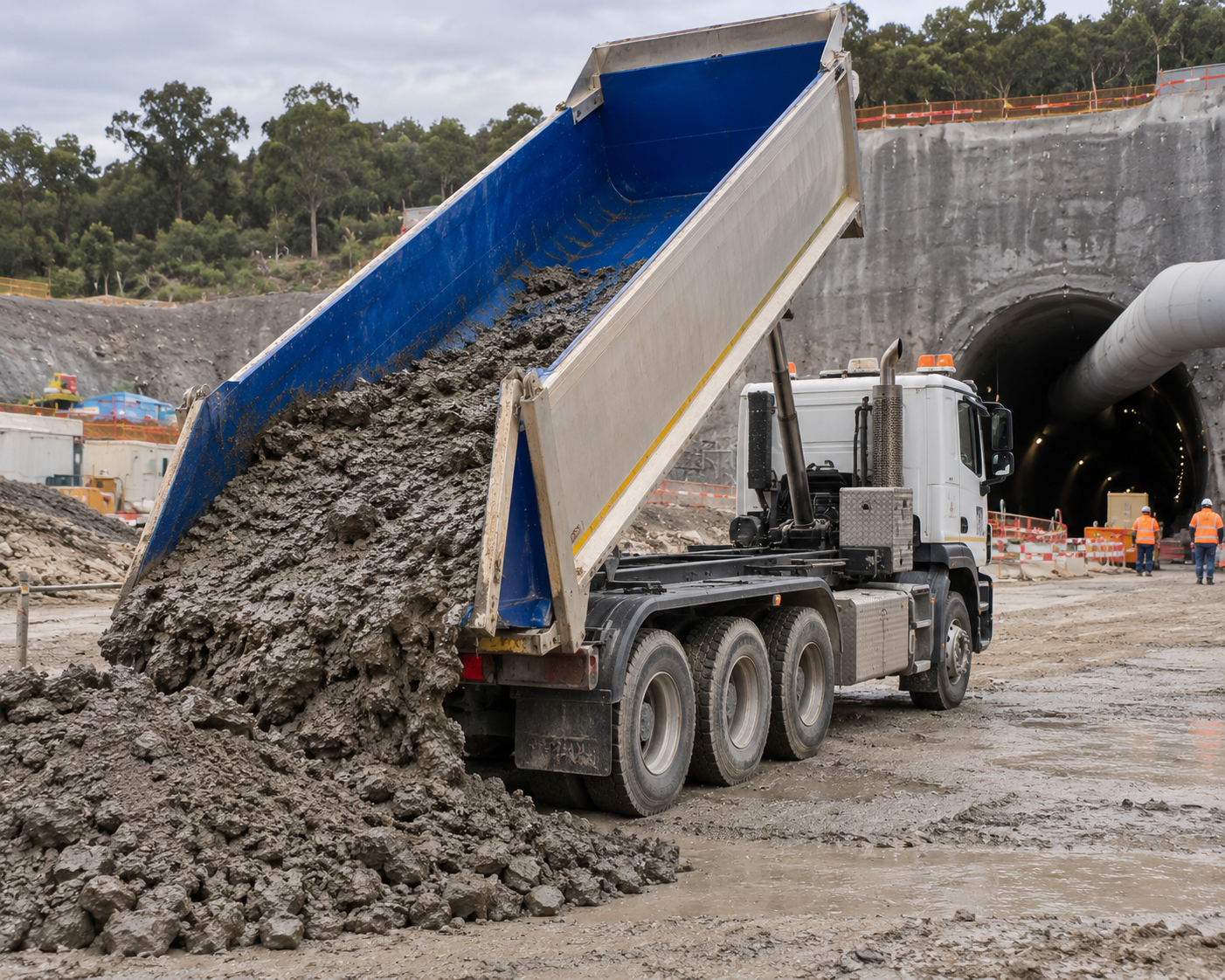
During tipping, the spoil may stay fixed against the body even as the angle increases. You can then find yourself raising the body further than usual before the load begins to move, with much of the material still held toward the front of the elevated body.
That retained mass raises the vehicle’s centre of gravity and reduces stability. Uneven hang-up can also shift the load away from the vehicle’s centreline. If one section releases while another remains stuck, or if the entire mass breaks free suddenly, the resulting change in weight distribution can destabilise the vehicle during an already elevated tipping cycle.
Soft or uneven ground, cross-slope, poor vehicle alignment and restricted tipping areas can further reduce the available safety margin. The risk develops through a clear sequence. Cohesive spoil resists movement, so the operator raises the body further to initiate discharge. The vehicle becomes less stable while a substantial portion of the load remains elevated.
How Tunnelling Sites Can Reduce the Risk
Reducing the risk requires controls that address both material hang-up and the conditions under which the truck tips. You need to improve material release, maintain stable tipping areas, manage load distribution, define operating limits and monitor discharge performance. Together, these controls address different points in the unloading sequence.
Use a Low-Friction Truck Body Liner
An OKUSLIDE® truck body liner reduces resistance between conditioned spoil and the floor and sidewalls. By helping cohesive material move earlier in the tipping cycle, OKUSLIDE® liners can lower the angle needed to initiate discharge and reduce the amount of spoil retained at elevation.
This supports a more controlled release and reduces exposure to sudden or uneven load movement associated with severe hang-up. Treat the liner as part of a broader tipping-risk strategy rather than a guarantee against rollover.
Establish Level and Stable Tipping Zones
While a liner addresses material flow, the tipping zone determines whether the vehicle has a stable base as the body rises. Unload spoil trucks on firm, level and compacted ground wherever reasonably practicable, with sufficient space to align the vehicle correctly before tipping.
Assess ground slope, drainage, waterlogging, soft edges, ruts and changes in surface level. Available manoeuvring space and overhead clearance must also suit the type and height of the tipper you’re operating. Repeated unloading in the same position can degrade the surface, so designated tipping areas require ongoing inspection and maintenance rather than a one-off assessment.
Review these conditions as excavation progresses, stockpile locations move or site access changes.
Control How Spoil Is Loaded into the Truck Body
Load preparation affects vehicle stability before you raise the body. Distribute the spoil evenly across the body rather than concentrating it towards the front or along one side, and keep each load within the vehicle and body manufacturers’ limits.
You should also account for changes in spoil density, moisture and flow characteristics. Spoil from different geological sections or conditioning regimes may consolidate and discharge differently. Clay content, retention time and the dosing of water, foam or polymer additives can all affect material release.
Loading practices should therefore respond to current spoil conditions rather than treating every load from the project as equivalent. Keeping the load centred does not resolve material hang-up, but it reduces the likelihood that retained spoil will create an off-centre mass when the body is elevated.
Set Tipping Limits and Stop-Work Triggers
Site procedures should define what happens when the spoil does not release as expected. Give drivers clear limits for ground slope, vehicle orientation and body elevation based on the tipper manufacturer’s requirements and the conditions of the unloading area.
If the spoil has not begun moving by the nominated angle, the operator should stop raising the body rather than continue towards maximum elevation. Rocking, jerking or moving the vehicle while the body is raised should also be prohibited.
Exclusion zones should keep personnel outside the potential rollover and discharge areas. Where a spotter is required, agree on the communication process before tipping begins, and keep the spotter outside the exclusion zone while they monitor vehicle alignment and material release.
Monitor Spoil Behaviour and Unloading Performance
Record the angle at which different spoil types begin to move and track recurring issues such as sidewall hang-up, carryback, uneven discharge and repeated tipping attempts. Comparing these observations with ground conditions, moisture levels, conditioning records and retention times can help identify changes in spoil behaviour.
Routine inspections should cover the truck body, liner surface, fasteners, tailgate and hydraulic system to rule out equipment condition as a cause of inconsistent discharge. Where high-angle tipping remains a recurring issue, an inclinometer or tipping-angle monitoring system can provide an objective reference for operators and site supervisors.
Sticky TBM spoil becomes a tipping hazard when it stays retained as the truck body rises. Uneven hang-up or sudden release at greater elevation can rapidly alter weight distribution and reduce vehicle stability.
Managing this risk depends on coordinated controls across material release, tipping-zone conditions, load distribution, operating limits and discharge monitoring. When matched to the truck body, spoil profile and operating conditions, an OKUSLIDE® truck body liner can help cohesive material release earlier, support lower tipping angles and reduce carryback.
If sticky spoil is causing repeated hang-ups or forcing trucks to tip at higher angles, contact our team to discuss a liner setup suited to your tunnelling fleet and unloading conditions.
FAQs
Do all TBM spoil create the same tipping risk?
No. The risk varies with ground composition, moisture content, particle size, conditioning agents and retention time. Clay-rich or heavily conditioned spoil may behave as a cohesive mass, while sandier or more granular material may release more freely.
Does the truck body design affect how TBM spoil discharges?
Yes. Floor length, sidewall angle, internal corners, tailgate design and body condition can all influence how easily cohesive spoil moves during tipping. Two trucks carrying the same spoil may therefore require different release angles.
Can OKUSLIDE® liners be customised for different equipment?
Yes. OKUSLIDE® liners can be specified for truck bodies, excavator buckets, chutes, hoppers and other bulk-handling equipment. Our team selects the liner format, thickness and fixing method based on the equipment geometry, parent material, load type and impact profile. OKUSLIDE® is available up to 40 mm thick for suitable heavy-duty applications, with the final setup matched to the equipment and operating conditions.