At a glance
- Clay-rich, moisture-heavy TBM spoil can remain sticky despite conditioning, making it difficult to move through transfer chutes.
- High surface friction, changes in flow direction and restrictive chute openings contribute to recurring spoil build-up.
- As spoil accumulates, conveyor transfer point blockages can interrupt material removal and delay tunnelling operations.
- OKUSLIDE® non-stick liners help reduce spoil retention at critical transfer points, supporting smoother discharge and more consistent material flow.
Continuous excavation during a tunnel boring machine (TBM) drive depends on reliable spoil removal. Conveyor systems carry that spoil out of the tunnel, so a restriction along the line can slow excavation.
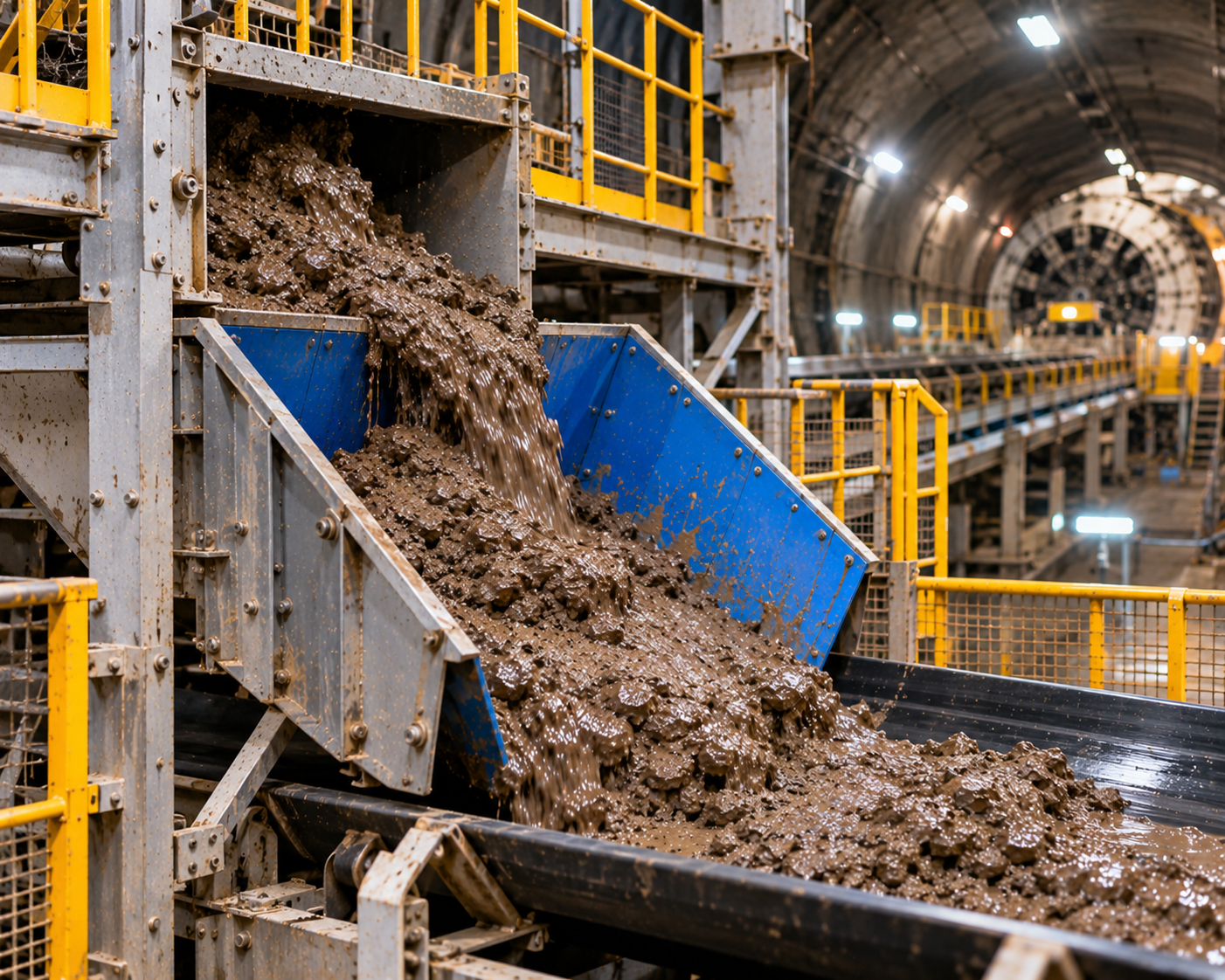
Soil conditioning improves spoil workability, but it does not always remove material-handling difficulties. Clay-rich fines combined with high moisture can keep conditioned TBM spoil cohesive and sticky against chute surfaces. Transfer points are especially exposed because spoil changes direction and loses momentum there, which increases accumulation along the chute walls.
Repeated build-up can gradually narrow the discharge opening, reducing the volume of spoil that can pass through the transfer point.
The following sections explain why this build-up forms at transfer points and how OKUSLIDE® non-stick chute liners can help keep spoil flowing.
What Causes TBM Spoil to Build Up at Conveyor Transfer Points?
Conveyor transfer point blockages can develop when cohesive spoil accumulates on chute surfaces faster than moving material can carry it away. Several material and equipment conditions contribute to this accumulation.
- Cohesive spoil consistency: Clay-rich fines, moisture and variable conditioning can produce cohesive spoil that forms sticky masses instead of flowing freely. These masses hold together under their own weight and resist movement through transfer chutes. Because ground conditions and conditioning dose change along the drive, the consistency does not stay constant.
- High friction against chute surfaces: Rough or worn steel increases resistance between the spoil and the chute wall. Conditioned TBM spoil tends to smear across these surfaces and leaves deposits that trap the material that follows. Abrasive fines wear the steel further, which roughens the surface and creates more places for spoil to accumulate.
- Abrupt changes in flow direction: Spoil loses momentum when it strikes an impact plate or turns between conveyors. With less momentum, cohesive material settles against the impact surface and builds up in one spot.
- Restrictive chute geometry: Shallow chute angles, narrow openings and stagnant zones allow cohesive spoil to accumulate and compact. The deposits gradually obstruct the flow path and leave less room for the spoil that follows.
- Irregular spoil discharge: Sudden surges in feed volume can overload a transfer section and compact material onto existing deposits. Cohesive spoil redistributes slowly, so a surge exceeds the available discharge capacity and raises the risk of blockage.
Together, these factors narrow the flow path and disrupt material movement through the transfer point. The resulting build-up leads to blockages, backlogs and spillage, and repeated clean-outs can force unplanned conveyor stoppages. If spoil removal cannot keep pace with excavation, TBM operations may also need to slow or pause.
How Non-Stick Chute Liners Help Improve Material Flow
Build-up starts when spoil adheres to the chute surface, so reducing that adhesion improves flow at its source. OKUSLIDE® is an engineered, low-friction liner system that can reduce material retention on suitable transfer chute surfaces. Here’s how it helps:
Helps Cohesive Spoil Slide Along Chute Walls
Conditioned TBM spoil clings to steel because its clay-rich fines and moisture make it cohesive and sticky. OKUSLIDE® uses selected low-friction additives to reduce resistance between this spoil and the chute surface. You can cut and fit the sheet to line chute walls, and the liner also covers the steel beneath it, which reduces direct wear on the chute surface.
On suitably inclined chute walls, lower surface friction lets conditioned TBM spoil slide more readily under gravity. Spoil that keeps moving is less likely to settle and form deposits that trap more material.
Reduces Spoil Retention at Impact and Direction-Change Points
At the handover between conveyors, spoil hits an impact plate or deflector and changes direction. It loses momentum there, and because it is cohesive, it smears against the surface instead of continuing along the flow path. These first deposits give later material something to adhere to.
OKUSLIDE® non-stick liners help spoil release from impact and deflection areas instead of staying attached. Because build-up at these points often starts with the first layer, reducing retention there limits the deposits that can obstruct later spoil.
Because these areas take direct impact, you need to assess the liner grade, thickness and fixing method for each transfer.
Limits Progressive Build-Up Around Transfer Discharge Openings
Conveyor transfer point blockages often begin as a thin layer around the discharge opening. As deposits grow, they narrow the opening and reduce flow capacity. A narrower opening also keeps spoil in contact with the surface for longer, which adds to the deposits at the same spot.
When you specify them correctly around discharge openings, OKUSLIDE® non-stick liners can reduce spoil retention and limit progressive build-up. A clearer discharge path also lowers the chance of repeated blockages in bulk handling systems at the same location.
Conditioned TBM spoil builds up at conveyor transfer points when sticky material meets high-friction steel, loses momentum at impact areas and collects around narrow discharge openings. Over time, the deposits lead to blockages and unplanned stoppages. OKUSLIDE® non-stick liners can reduce spoil retention on suitable chute surfaces, including the walls, impact points and discharge openings, which supports more consistent flow.
If you want to reduce conveyor transfer point blockages on your project, OKUSLIDE® can recommend a non-stick liner suited to your application. Contact the OKUSLIDE® team to discuss your spoil characteristics, conditioning agents and chute geometry.
FAQs
What are the early signs of developing conveyor transfer point blockages?
Uneven spoil discharge, increasing spillage around transfer points, visible material accumulation and recurring conveyor interruptions all point to a developing restriction. Spotting these signs early lets your maintenance team act before the restriction stops the conveyor.
Can soil-conditioning agents affect the suitability of a conveyor chute liner?
Yes, soil-conditioning agents affect chute liner performance. In mechanised tunnelling, foams, polymers and bentonite change the properties of the excavated spoil, which alters how it interacts with the liner.
Why can conditioned TBM spoil bridge inside receiving hoppers even after passing through a conveyor transfer chute?
Bridging depends on spoil cohesion and outlet geometry, so a clear transfer chute does not rule it out. Cohesive spoil can arch across a hopper outlet and block it. Material bridging in hoppers is a separate flow problem that needs its own assessment of the outlet and surfaces.
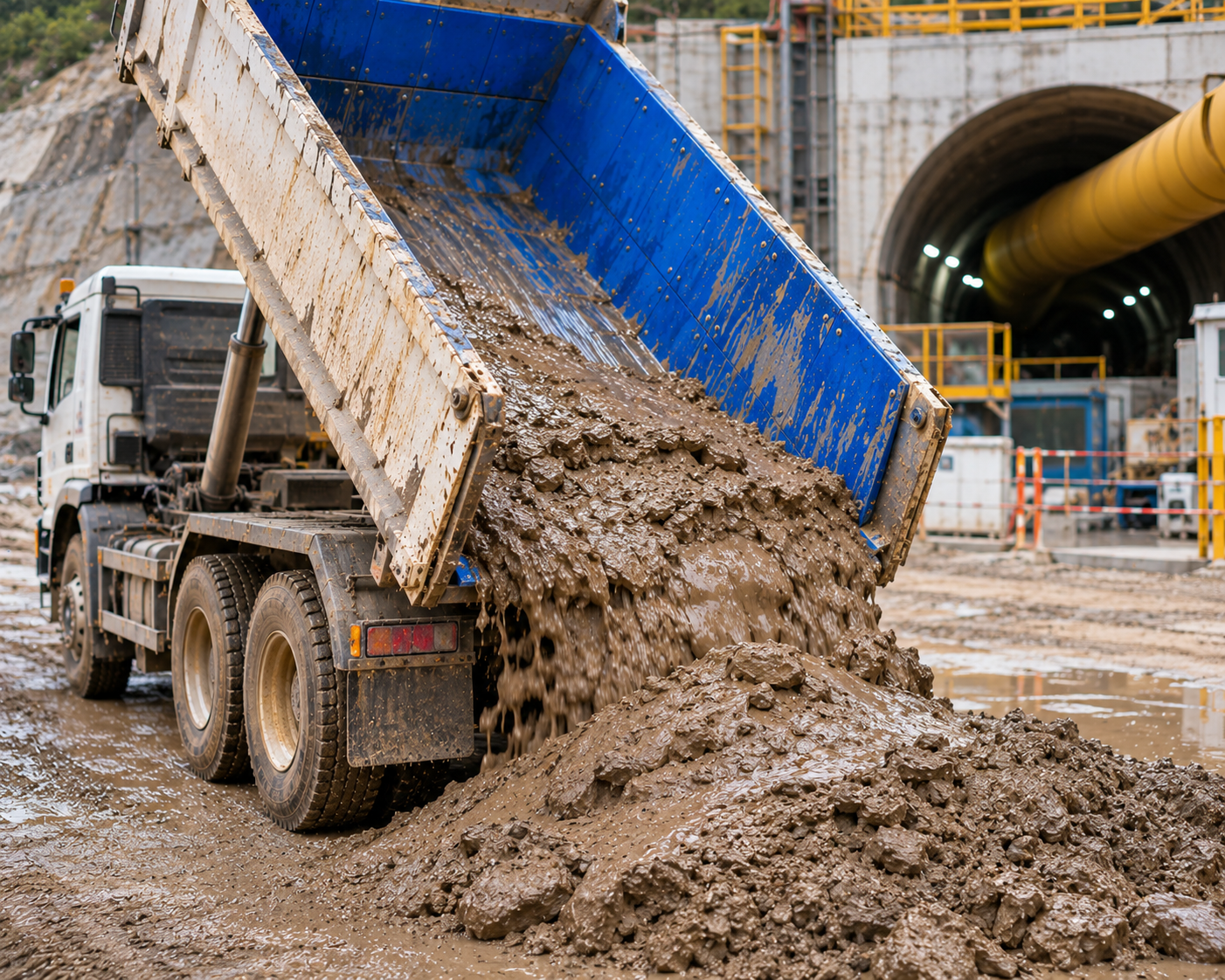
Why does conditioned TBM spoil sometimes stick inside haulage trucks after moving successfully through conveyor systems?
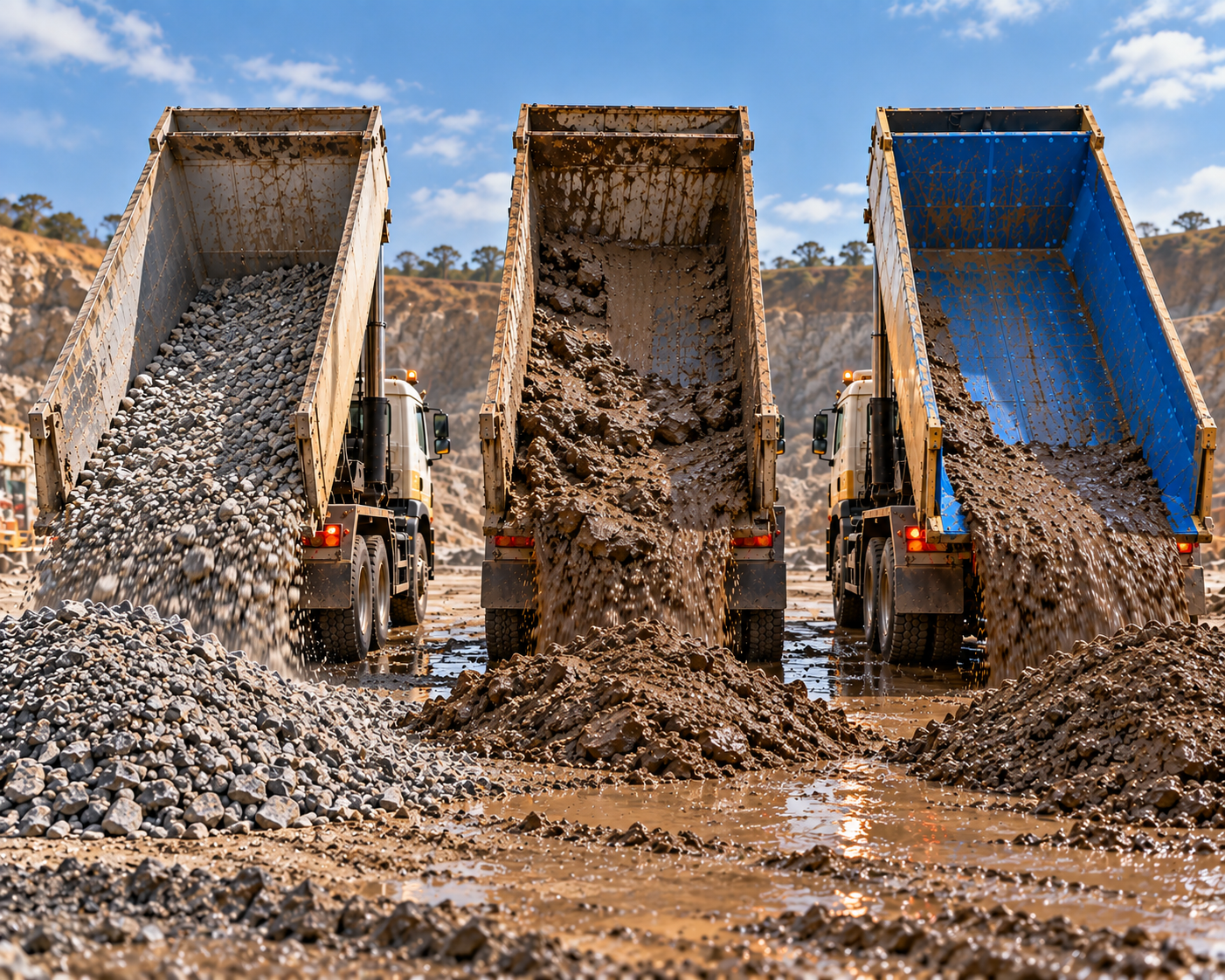
Truck bodies and conveyor chutes involve different loads, surfaces and discharge conditions. In a tray, spoil compacts under load and must slide as the body tilts, so retention depends on the tray surface and the tipping angle. Conditioned spoil behaves differently from ordinary fill in dump truck trays, so a load that cleared the conveyor can still stick in the tray.