At a glance
- Moisture can increase cohesion between clay and fine particles, turning a free-flowing load into a cohesive mass that resists discharge.
- Material flowability can change during transport as loads settle and consolidate inside the tipper body.
- Understanding material density and flowability before tipping helps operators assess the risks associated with retained loads.
- Abrasion resistance protects against wear, but a low-friction liner can help wet and cohesive materials release more readily.
Material that discharges cleanly from a tipper body in dry conditions may stick to the body surface after exposure to rain. Dry crushed rock and aggregate generally move as loose particles, while wet fines and clay-rich material can form a cohesive load that resists release.
In mining operations, rainfall, material processing and changing site conditions can alter material flowability, causing loads to discharge more slowly, hang up or remain partially retained in the tipper body.
Understanding these characteristics before unloading supports both safer tipping and more suitable liner selection.
The sections below set out how moisture, clay, fines and consolidation change flowability. They also explain why abrasion resistance alone is not enough, since a low-friction liner can help cohesive loads release more readily.
What Is Material Flowability and Why Does It Matter Before Tipping Mining Loads?
Material flowability is the ability of bulk material to move and discharge from a tipper body, shaped by the material’s characteristics and how it interacts with the body surface. It matters before tipping mining loads for these practical reasons:
- Predicting discharge behaviour: Understanding flowability helps operators anticipate whether a load will discharge progressively as the body rises or resist movement and release later in the tipping cycle.
- Identifying potential material hang-up: Recognising materials with poor flowability before unloading helps operators identify loads that may remain inside the tipper body, particularly around corners, weld lines and surface irregularities.
- Understanding retained load and stability risks: Knowing the density and flowability of a material helps operators judge the consequences of material remaining elevated during discharge, when retained load can affect stability.
- Recognising changes in load conditions: Operators need to account for the material’s current moisture content and retention time rather than rely solely on previous tipping experience.
- Informing appropriate risk controls: Knowledge of flowability supports decisions about unloading procedures, monitoring for sticking and body-liner selection as part of wider risk management.
How Moisture, Clay and Fines Change Bulk Material Flowability
Moisture, clay and fines are the main variables that move a load along the range from free-flowing to cohesive. Their effect on material flow in tipper bodies is easiest to follow by starting with a dry baseline and adding each variable in turn.
Dry Aggregate Moves as Loose Particles During Discharge
Dry, coarse aggregate such as crushed rock or gravel generally moves across a truck body liner as separate particles rather than as a cohesive mass. Gravity helps the particles move towards the discharge point, while individual particles make localised contact with the liner surface.
Particle size, angularity and interlocking still influence movement where moisture-related cohesion is limited. Angular particles can interlock and slow movement at corners and narrow sections even when little moisture is present. Dry aggregate generally separates cleanly once tipping begins and meets comparatively little resistance, and this behaviour is the baseline for the changes described below.
Moisture, Clay and Fines Increase Material Cohesion
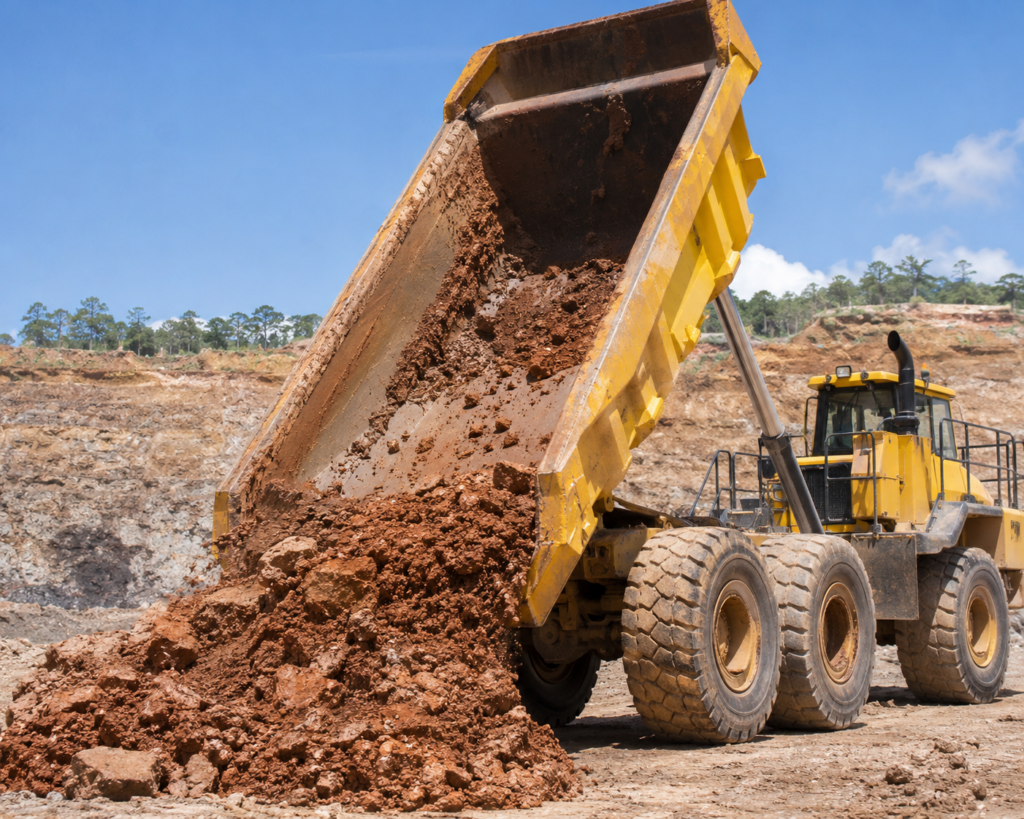
Moisture creates liquid bridges between particles, which increase cohesion and restrict independent particle movement. Clay and fines hold water and bind particles together, so saturated clay, wet fines and water-rich spoil tend to form a cohesive mass rather than moving as loose particles. Cohesive bulk materials of this kind resist the separation that progressive discharge depends on.
Damp aggregate is not the same as slurry. A wet aggregate load only becomes a slurry if it has an excess of fine particles and enough liquid (water) to suspend those solid particles into a fluid or semi-fluid mixture.
In mining, rainfall or material processing can increase the moisture content of iron ore fines and clay-rich overburden, potentially making these materials more difficult to discharge. The change may appear as increased hang-up, carryback, delayed discharge and higher tipping angles rather than visible liner damage.
Material Consolidation Can Change Flowability During Transport
Bulk material can settle and consolidate under its own weight when retained in a tipper body for an extended period. Particle rearrangement, compaction and moisture redistribution can alter flowability, meaning a load that flowed readily during loading may resist discharge at the unloading site.
WorkSafe Victoria’s alert Semi tippers overturning while unloading (2020) describes a mine incident involving consolidated material. A B-double’s front trailer rolled onto its side while unloading gypsum on flat ground. The material had consolidated after an extended time in the trailer and stuck during unloading. WorkSafe Victoria’s mine and quarry alerts and Mobile plant rollovers in quarries (2021) both list consolidation within trailers, due to retention times or physical property change, as an unloading hazard.
Slurry Loads Can Resist Release During Tipping
Slurry-like material can spread across the floor, corners and lower sidewalls of a truck body, creating broader, more continuous contact with the liner than coarse aggregate. The slurry’s consistency and its interaction with the liner surface can influence how readily it discharges.
Friction between the material and the liner, together with internal cohesion, can delay release as the body rises, so material stays retained until the body reaches a higher angle. More material is then held at height, which adds a stability consideration. When saturated clay-rich spoil remains in the body after tipping, material hang-up becomes carryback, reducing usable capacity on the next load.
What Mine Operators Need to Understand About a Load Before Tipping
Load characteristics seen at loading may not hold at discharge, as rainfall, time in the body and haul conditions can change them along the way. The table below summarises what operators and engineers should know when assessing discharge behaviour.
| Material Consideration | What Operators Should Understand |
| Material type | Whether the load behaves as loose granular material, a cohesive mass or a slurry |
| Moisture content | Whether rainfall or processing has changed moisture content and consistency |
| Clay and fines content | Whether clay-rich or fine particles are likely to increase cohesion and resistance to flow |
| Bulk density | The mass of material per unit volume and what retained material means during tipping |
| Retention time | Whether extended time in the body has allowed the material to settle, compact or consolidate |
| Previous discharge behaviour | Whether comparable loads have stuck, released unevenly or left carryback |
WorkSafe Victoria’s alerts Semi tippers overturning while unloading and Mobile plant rollovers in quarries both recommend that employers, including mine and quarry operators, ensure the density and flowability of material being unloaded is known and understood, and that material in trailers is monitored during unloading to check whether it is sticking. Material characteristics alone cannot establish how every load will behave, so monitoring during discharge remains necessary.
Why Abrasion Resistance Alone Is Not Enough for Changing Load Conditions
Abrasion resistance protects a liner against wear, while low friction helps material release. A liner chosen for dry aggregate may release cohesive material poorly once the load changes, not because it has weakened, but because the operating requirements have. Since mining loads shift with rainfall, processing and stockpile conditions, a specification that combines wear resistance with low-friction flow suits them better, as seen in wet and dry material transport.
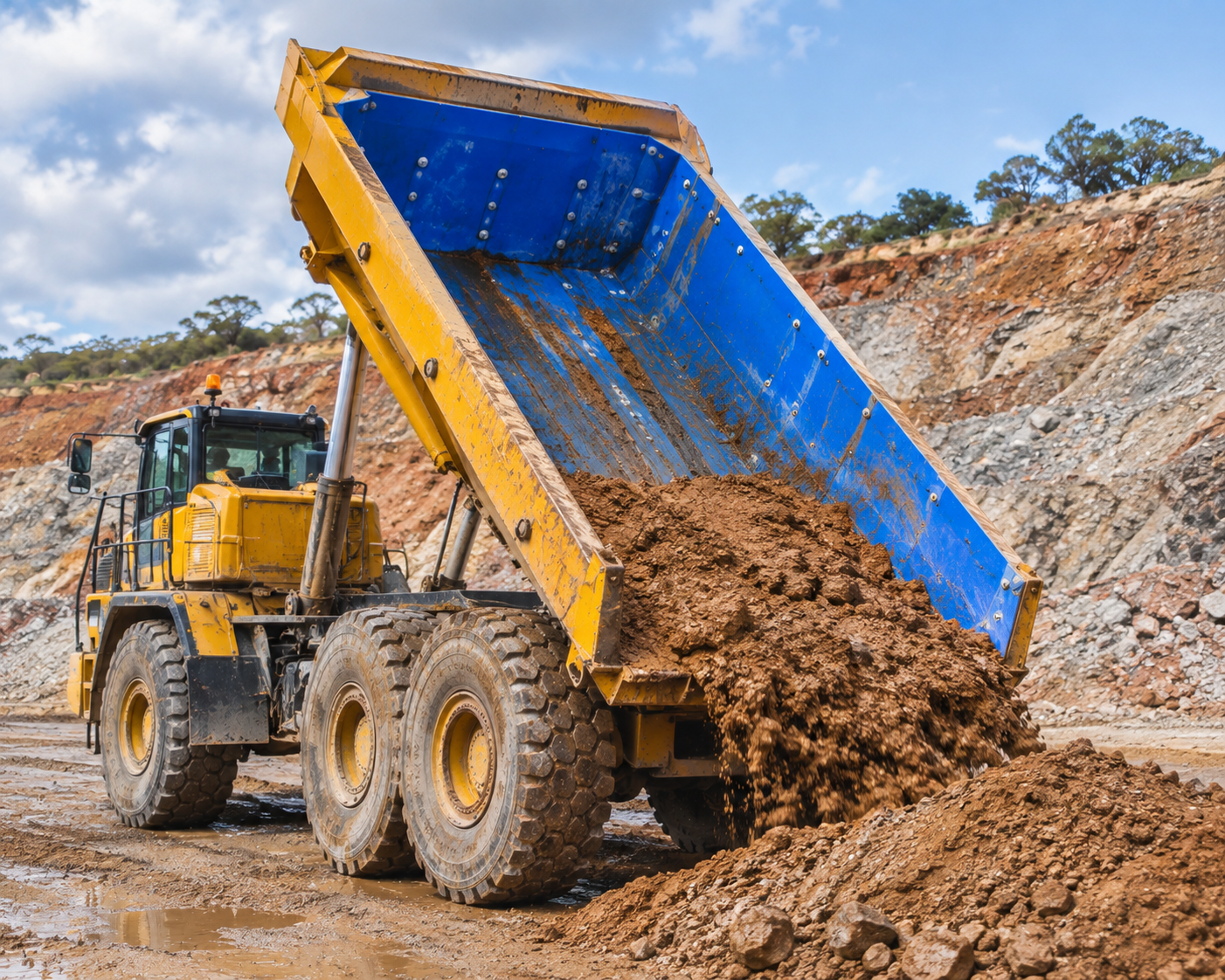
OKUSLIDE® is a low-friction UHMWPE liner system that pairs the abrasion resistance of its base material with additives that help wet, cohesive loads release more readily. This can reduce hang-up, carryback and the body elevation needed for discharge, depending on material, body geometry and operating conditions. Tipper body liners remain one control among several, alongside ground preparation, monitoring and systems of work.
Material flowability in tipper bodies shifts with moisture, clay, fines and consolidation, even when the material itself stays broadly the same. A load that releases progressively when dry can resist release when wet, consolidated or slurry-like, affecting retained load and the body elevation needed. Understanding both the material and how similar loads have discharged helps operators manage retained-load hazards, with low-friction liners as one control within broader mobile-plant risk management.
Flowability changes with moisture, time in the body and the material itself, so a liner can only be assessed against the load it will carry. Operators and engineers handling cohesive and changing loads are welcome to discuss assessment criteria with OKUSLIDE®, which is preparing a technical evidence framework for slick-surface body-liner systems on mobile equipment.
FAQs
Does truck body shape still affect slurry discharge with a low-friction liner?
Yes. Body shape and slope still influence slurry discharge even with a low-friction liner. Steeper sidewalls and well-designed corners support release, while flatter sections or tight corners can still retain cohesive material regardless of surface friction.
How is bulk material flowability measured?
Bulk material flowability is assessed through laboratory bulk-solids testing, which examines properties such as cohesion and response to compaction, along with site observation of how comparable loads discharge. Engineers select the method to suit the material and the purpose of the assessment. Test results do not replace monitoring for sticking during unloading.
Can OKUSLIDE® be retrofitted to an older truck body?
Yes, OKUSLIDE® can generally be retrofitted to older truck bodies with consultation from the OKUSLIDE® engineering team. Thin or worn skins may need extra preparation, such as welding, depending on their condition.
How is the right OKUSLIDE® liner thickness selected for different loads?
Material type, particle size, impact profile and your truck body’s condition determine the right OKUSLIDE® liner thickness for your load, not a single default.