At a glance
- Material sticking inside a raised tipper body can shift the centre of gravity and increase rollover risk.
- Australian safety regulators address tipper hazards through incident alerts and broader mobile plant risk-management frameworks.
- NSW and Victorian safety reports identify material hang-up as a contributor to tipper instability, with NSW also highlighting carryback as a rollover risk.
- WorkSafe Victoria’s tipper rollover alert lists non-stick liners among its recommended ways to control risk, to reduce the height the body needs to be elevated.
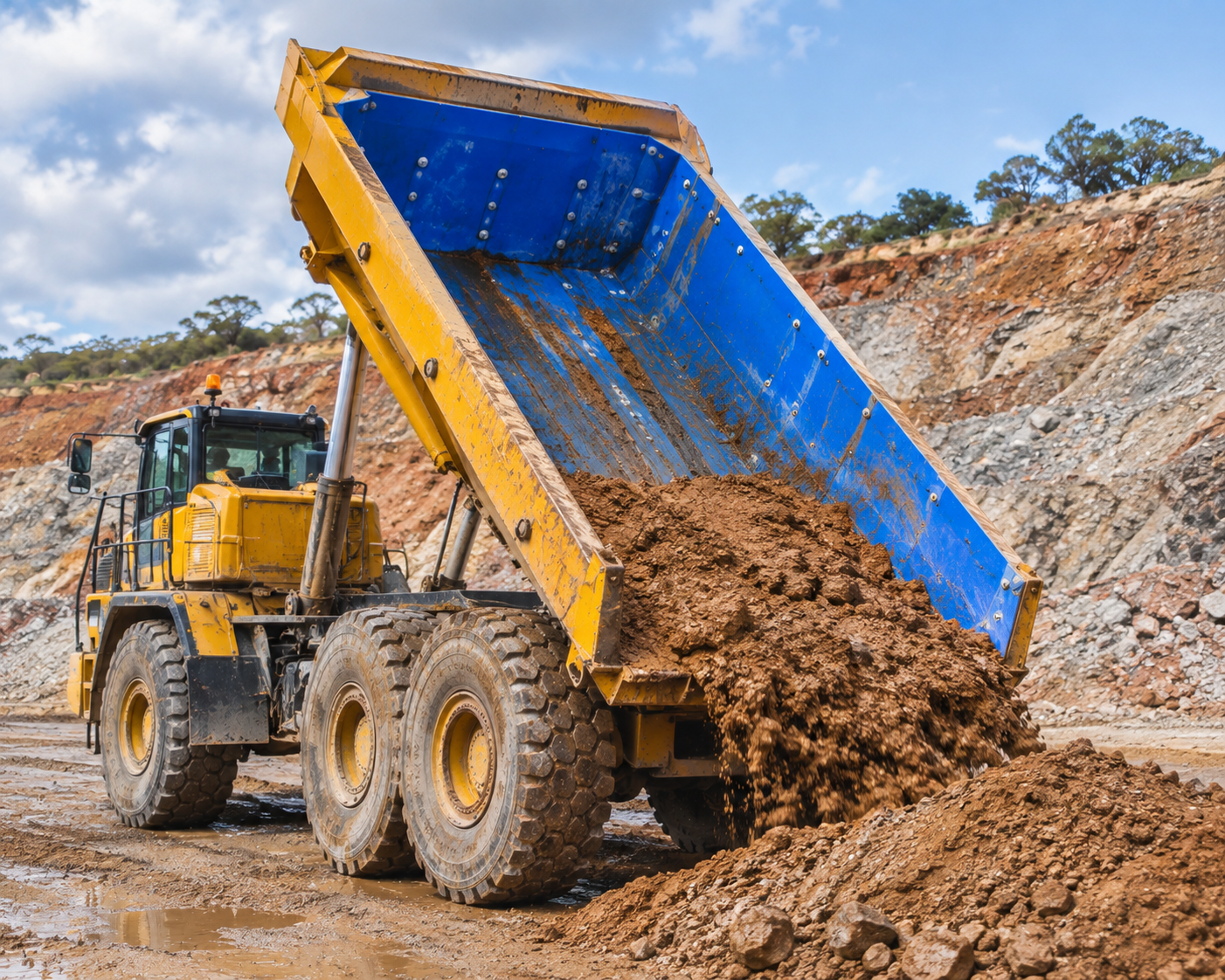
When a tipper body is raised for unloading, sticky, wet or consolidated material may remain inside. Clay, damp fines and materials that have consolidated during transport can adhere to the floor and walls, leaving part of the load inside as the body is elevated.
That retained load can alter weight distribution and raise the effective centre of gravity, reducing stability at full elevation. The hazard applies across mining, quarrying, construction and bulk material transport.
Australian safety authorities address these hazards through incident alerts, operating guidance and broader risk-management frameworks. Some also identify non-stick liners as a potential control.
The sections below set out what each regulator says about material sticking, and where a low-friction liner fits as one control among several.
Who Regulates Tipper and Mining Safety in Australia?
Tipper and mining safety in Australia is regulated mainly by state and territory authorities, while Safe Work Australia develops national policy.
Safe Work Australia is a national policy body that does not regulate work health and safety laws. The Commonwealth, states and territories regulate and enforce them within their own jurisdictions.
In practice, that means different authorities publish the safety alerts and guidance for tippers. The NSW Resources Regulator is responsible for work health and safety at mines and petroleum sites in New South Wales, and Resources Safety and Health Queensland (RSHQ) is the independent regulator for mining, quarrying, petroleum, gas and explosives in Queensland. WorkSafe WA publishes mine safety codes, while WorkSafe Victoria administers the state’s own Occupational Health and Safety Act 2004.
What Do Australian State and Territory Safety Regulators Say About Tipper Safety?
Tipper rollover safety guidance in Australia varies in scope. Some regulators document incidents involving material hang-up directly, while others address mobile plant risk through broader frameworks.
Western Australia: WorkSafe WA
WorkSafe WA published its Road and Traffic Management at Western Australian Mines Code of Practice on 4 August 2026. Approved under section 274 of the Work Health and Safety Act 2020 (WA), the code provides guidance on mine-site traffic management, haul road design and the safe selection, operation and maintenance of powered mobile plant.
For mining mobile plant safety, the code lists stability under all foreseeable operating conditions among factors to consider before buying a plant. It also says tipping procedures should include maintained edge bunds, windrows or berms and clearly marked dump locations.
It is a broader risk-management framework, and its sections on plant selection, operating practices and tipping operations do not refer to material sticking or tipper body liners.
Queensland: RSHQ and WorkSafe Queensland
RSHQ is the independent regulator of worker safety and health in Queensland’s mining, quarrying, petroleum, gas and explosives industries. Tipper guidance comes from WorkSafe Queensland, whose general workplace alert, Working near, or on, tip trucks and tipper trailers, was issued in November 2024. The alert identifies sticky material remaining near the upper end of a raised tipper body as a factor that can increase the risk of overturning.
The alert identifies ground slope and ground conditions as common contributing factors in tipper overturning incidents. Depending on site conditions, the alert recommends implementing controls for material sticking, particularly where unloading areas are not flat and level.
New South Wales: NSW Resources Regulator
The NSW Resources Regulator’s Safety Bulletin SB25-03 (May 2025) reports a rising trend in mining truck rollovers. A review of 40 notified incidents identified three predominant causes: poor ground conditions at tip heads and dump areas; hang-up and carryback in trays causing poor centres of balance and trucks tipping; and run-out tipping (discharging load while the vehicle is moving). The bulletin recommends tipping procedures that ensure loads are centred, material flows during discharge and carryback is managed.
The NSW Resources Regulator’s 4 August 2023 incident summary records a road-registered 10-tonne tipper truck that partially rolled over slowly at an underground coal mine because washery spillage material hung up in the tray. The listed actions include considering the most appropriate truck type for the material, monitoring for hang-up, and reporting unsafe conditions to a supervisor. The summary states that the regulator does not endorse the findings or recommendations of the incidents it lists.
An earlier bulletin, SB17-01, recommends checking for hang-up while tipping and knowing material density and flowability.
Victoria: WorkSafe Victoria
WorkSafe Victoria’s tipper rollover alert (July 2022) followed an incident in which a traffic controller was fatally injured when the trailer of a tip truck rolled while unloading gravel into a culvert. It states that large volumes of solid or wet material sticking to the trailer body can alter the centre of gravity when the body is elevated, and that rollover risk increases the higher the body is elevated. Under Recommended ways to control risk, it lists using trailers with non-stick liners to reduce the height the body needs to be elevated.
Two further alerts cover mines and quarries. Semi-tippers overturning while unloading (February 2020) describes roadbase sticking in a raised trailer and gypsum consolidating over time. The quarry rollover alert (March 2021) flags material consolidation and advises monitoring for sticking during unloading.
How Non-Stick Body Liners Can Help Manage Material Hang-Up
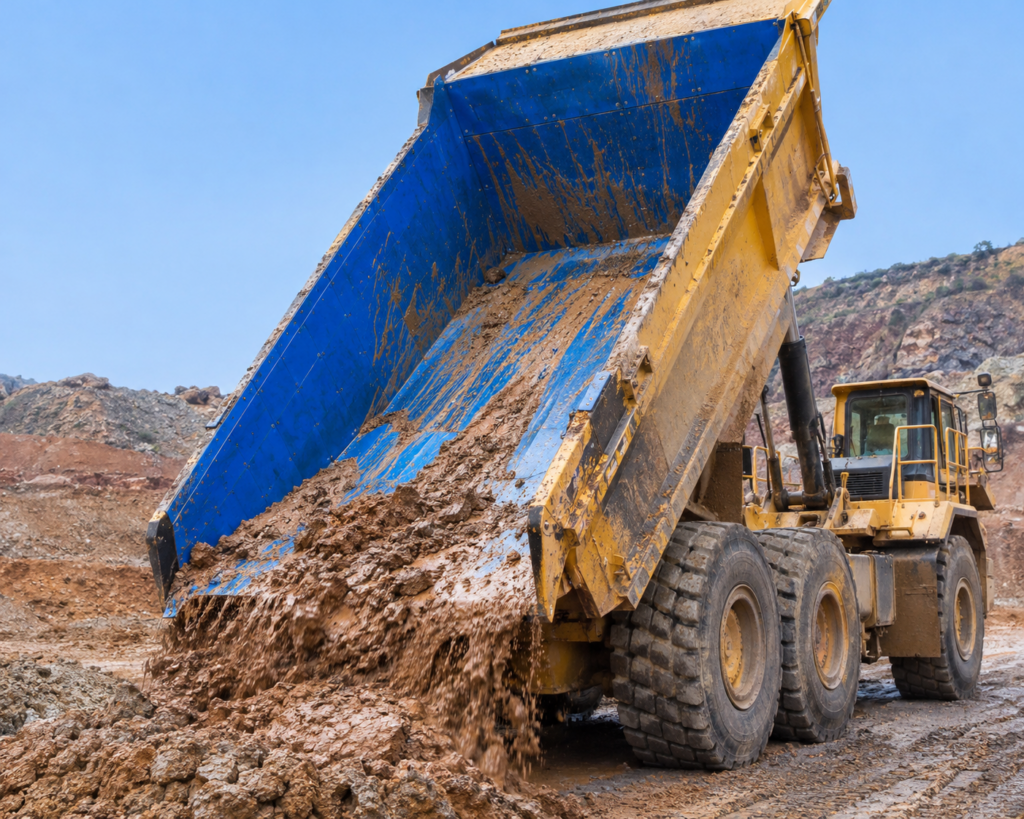
A non-stick liner like OKUSLIDE® is designed to assist the release of cohesive or wet material during tipper discharge. WorkSafe Victoria’s tipper rollover alert refers to non-stick liners in general, listing the use of trailers with non-stick liners among its recommended ways to control risk, to reduce the height the body needs to be raised. Here is how non-stick body liners can help manage material hang-up:
- Reduced surface friction: Selected additives lower the liner’s friction coefficient, so sticky or wet material may release more readily. The effect depends on the material, its moisture content and the condition of the body.
- Lower tipping angles: Earlier release can mean the body needs less elevation to discharge, and WorkSafe Victoria’s alert states that rollover risk increases the higher the body is elevated.
- Reduced carryback: Better release leaves less material in the body after tipping, giving more consistent discharge. The NSW Resources Regulator names carryback as a rollover cause, so clearing more of the load helps keep the body balanced.
- Wear protection: The liner acts as a protective layer between abrasive material and the truck body, reducing abrasion. This is a secondary benefit, outside the regulators’ stated reasons for listing liners.
- Application-specific risk control: A liner is one engineering control among several, alongside plant selection, tipping surface preparation, interlocks and monitoring. Selection and installation are site-specific, and measuring performance before and after installation helps confirm the result.
Australian regulators address tipper stability at different levels. Victoria and New South Wales publish incident-based alerts, Western Australia sets a broader mobile plant framework and Queensland issues general guidance. Common threads are stable discharge conditions, suitable equipment, an understanding of material behaviour and effective risk controls. Non-stick liners appear as a listed control in WorkSafe Victoria’s tipper rollover alert, where they sit as one measure among several.
Operators assessing how that measure applies to material sticking in tippers on their own sites, contact OKUSLIDE® to discuss non-stick tipper body liners and where they fit within existing risk controls.
OKUSLIDE® is developing a technical evidence framework for the assessment of slick-surface body-liner systems used on mobile equipment. OKUSLIDE® welcomes technical engagement with mine operators, engineers, safety regulators and industry bodies regarding appropriate assessment, installation, inspection and verification criteria. Operators who wish to open that discussion are free to contact OKUSLIDE® directly.
FAQs
Are tipper safety regulations the same across all Australian states and territories?
No. Each jurisdiction regulates and enforces its own work health and safety laws. The model WHS laws are in force in every jurisdiction except Victoria, which uses its own Occupational Health and Safety Act 2004.
Does installing a body liner change a tipper truck’s allowable payload?
No. A liner doesn’t change the mass limits that apply to the vehicle, but it does add weight to the body, so the payload you can carry within those limits should be checked after fitting. The liner choice affects payload compliance because of that added weight.
Can non-stick liners be retrofitted to older tipper bodies?
Yes, but suitability depends on the body’s condition, parent material and fixing method, so it’s best to get technical advice before fitting. Retrofitting is covered in more detail in the article on retrofitting liners to older truck bodies.